> SYSTEM_LOG // CASE_STUDY_02 // LUMA_DESIGN_SYSTEM // 8_ACTS

LUMA — Design once. Connect everything.
Scale with intent.

A design system designed as a product, not a UI kit. LUMA is a connected operating framework that bridges design decisions, token graphs, component contracts, release operations, and stewardship evidence across 8 sequential acts.

[ ROLE ]
Design System Architect & Lead Designer
[ ARCHITECTURE ]
8 Sequential Acts · 55 Decision Nodes
[ CORE DOMAINS ]
Tokens, Contracts, Operations, Governance
[ TOOLING ]
Figma Variables, Design Tokens, Web & Mobile
Case Study Format: 8 High-Resolution Sequential Acts. Click any Act to inspect in full resolution.
Begin Act 01
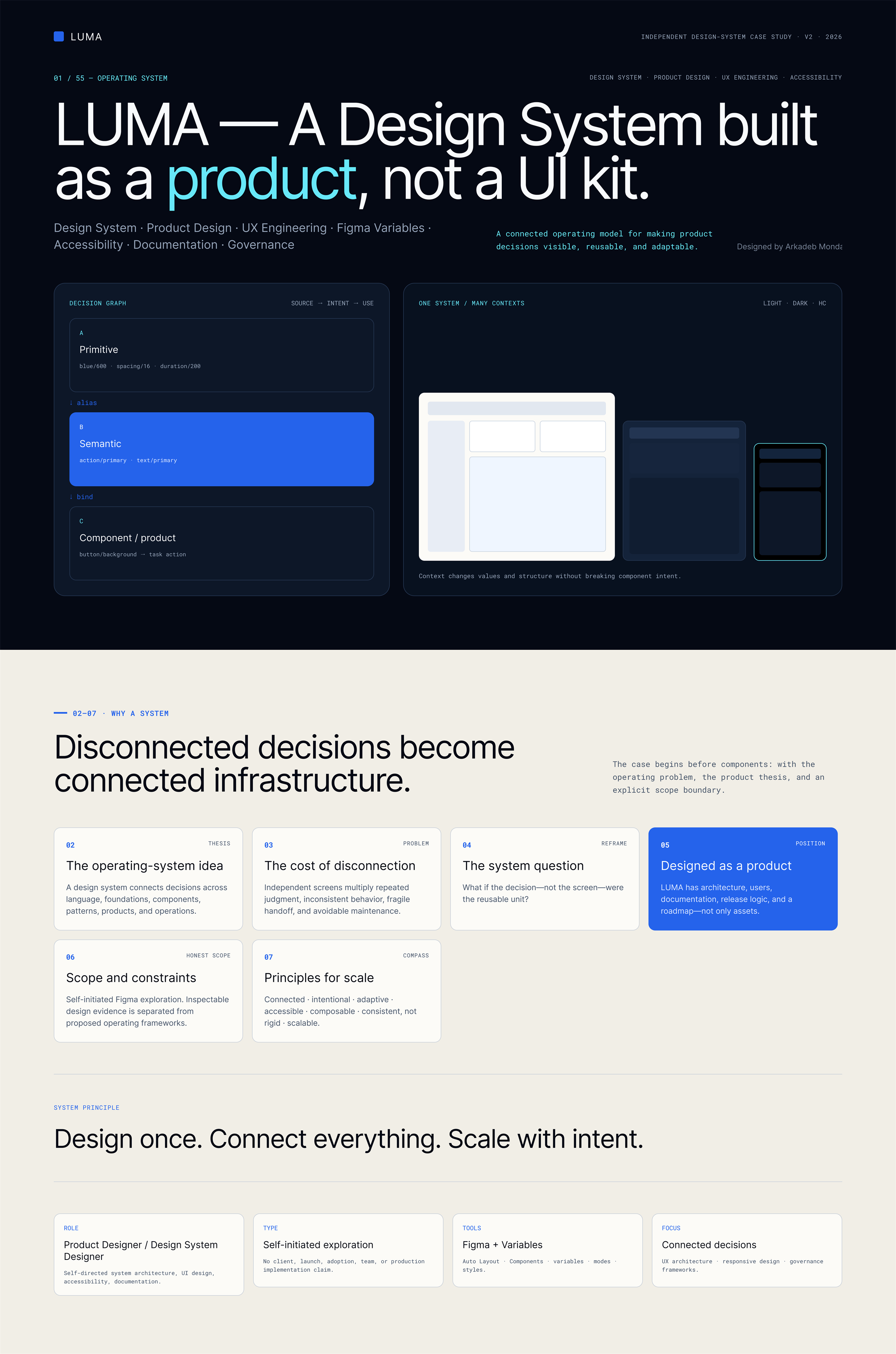
ACT 01 // 08 THE OPERATING SYSTEM

LUMA — A Design System built as a product, not a UI kit

The operating problem, the product thesis, and an explicit scope boundary. Architecture before inventory.

LUMA Act 1 — Premise and Operating System. High resolution presentation board.
Click to zoom & inspect
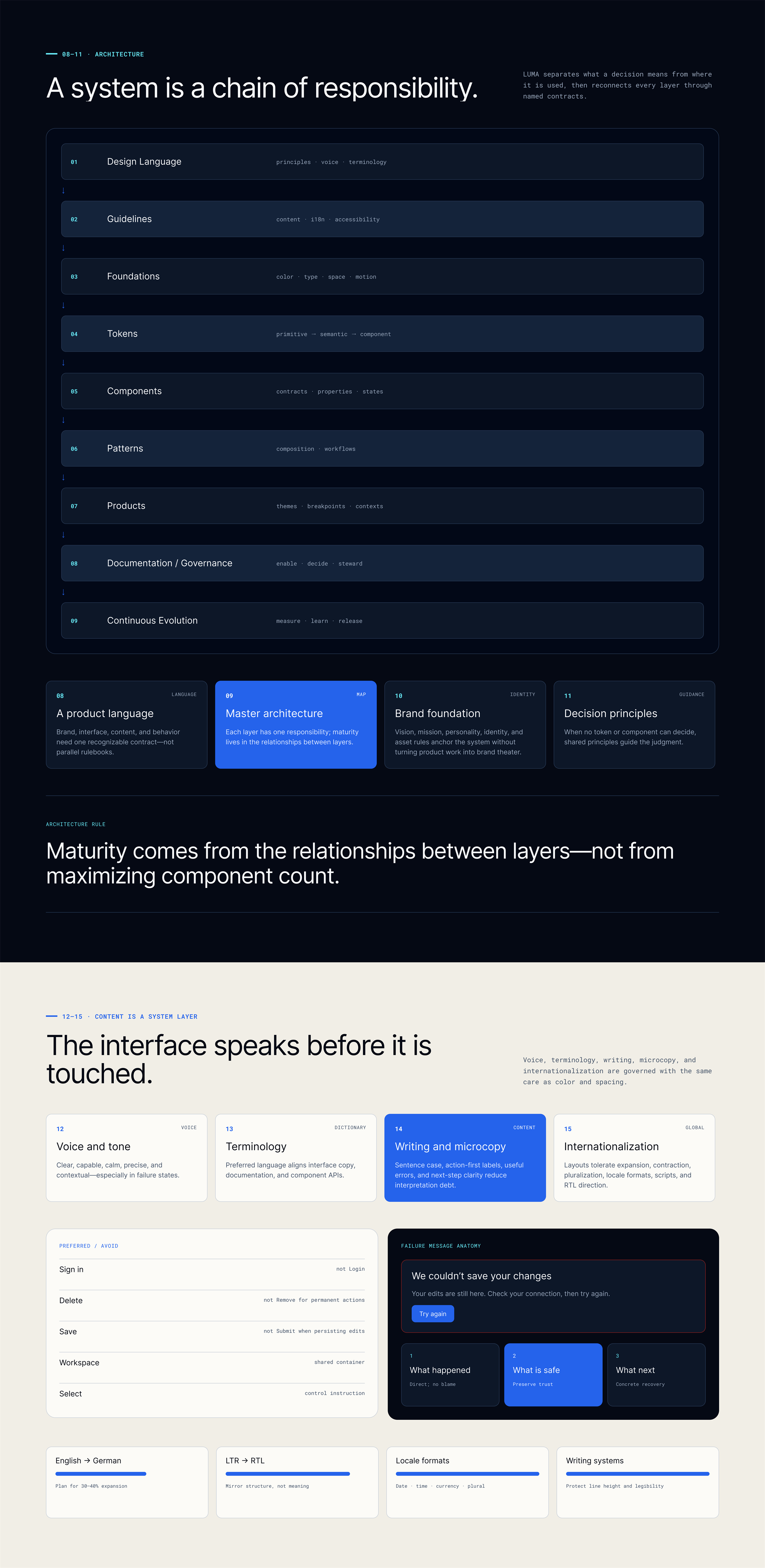
ACT 02 // 08 LANGUAGE & ARCHITECTURE

Semantic taxonomy and three-tier token hierarchy

Primitive, semantic, and component token structures with strict alias binding and cross-platform naming rules.

LUMA Act 2 — Language and Architecture. Semantic taxonomy, token hierarchy, and decision graph.
Click to zoom & inspect
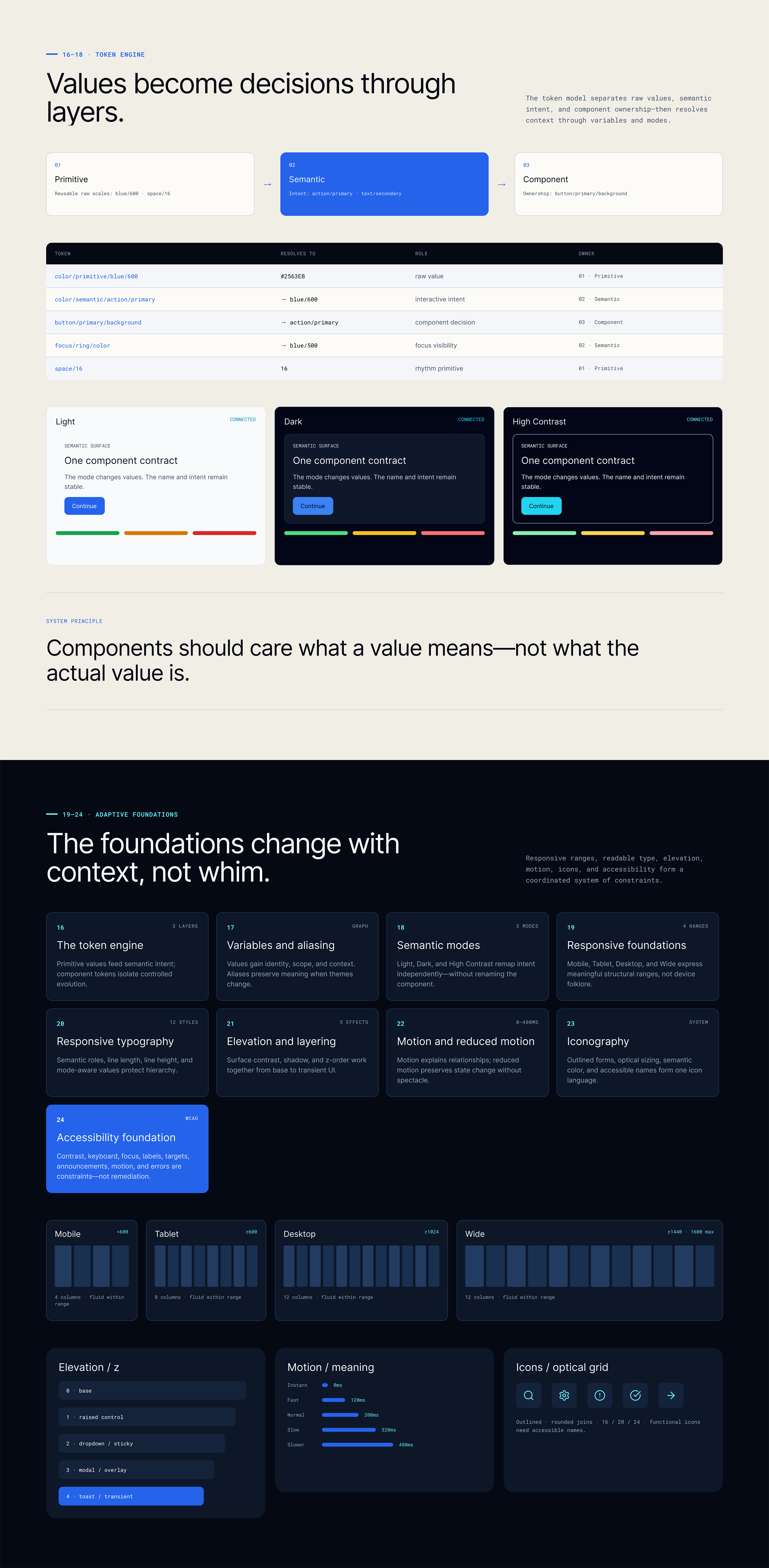
ACT 03 // 08 FOUNDATIONS & TOKENS

Foundational constraints, scales & accessibility boundaries

Color ramps, accessibility contrast thresholds, typography hierarchies, layout grids, elevation, and motion curves.

LUMA Act 3 — Foundations and Tokens. Color systems, typography scales, layout grids, and motion.
Click to zoom & inspect
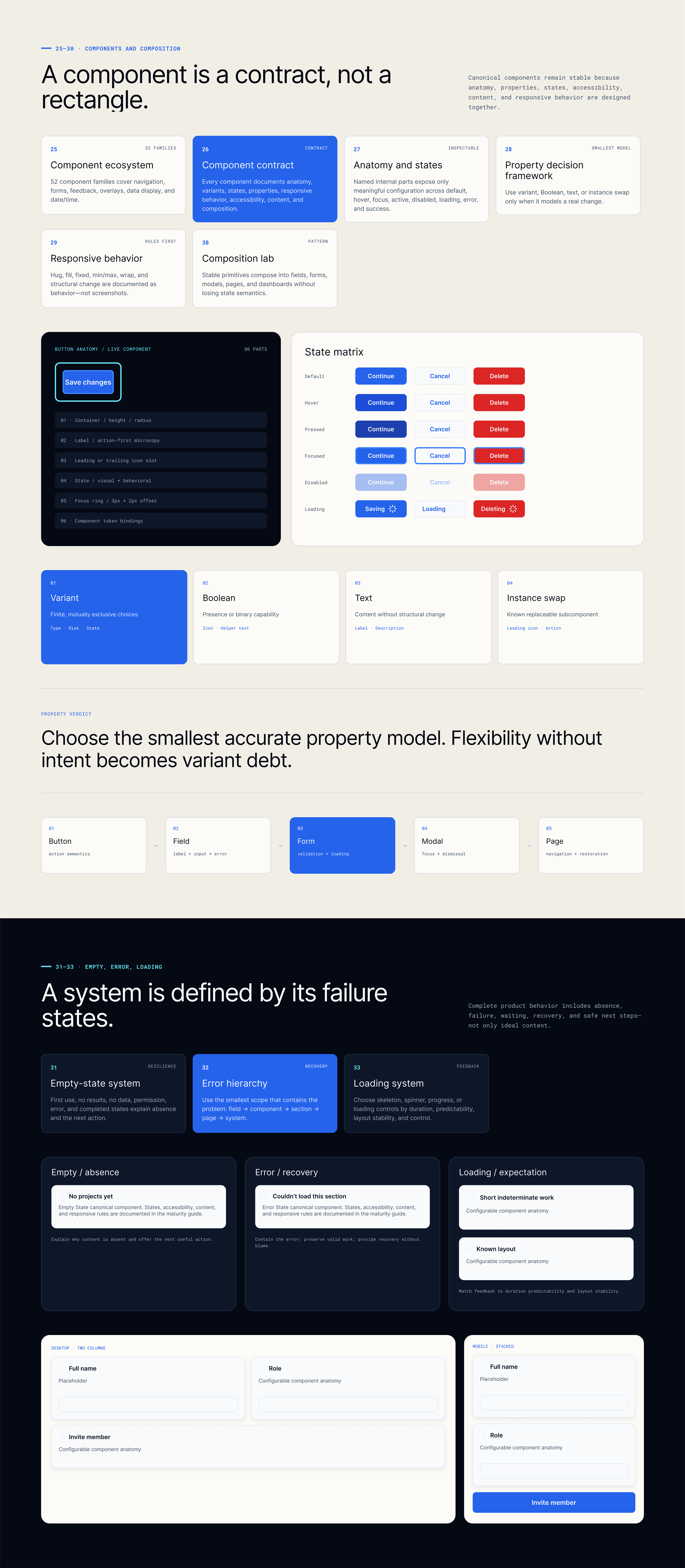
ACT 04 // 08 COMPONENT ECOSYSTEM

A component is a contract, not a rectangle

Component anatomies, state matrices, property decision frameworks, variant debt reduction, and empty & error failure states.

LUMA Act 4 — Component Ecosystem. Component contracts, state matrix, and failure state hierarchy.
Click to zoom & inspect
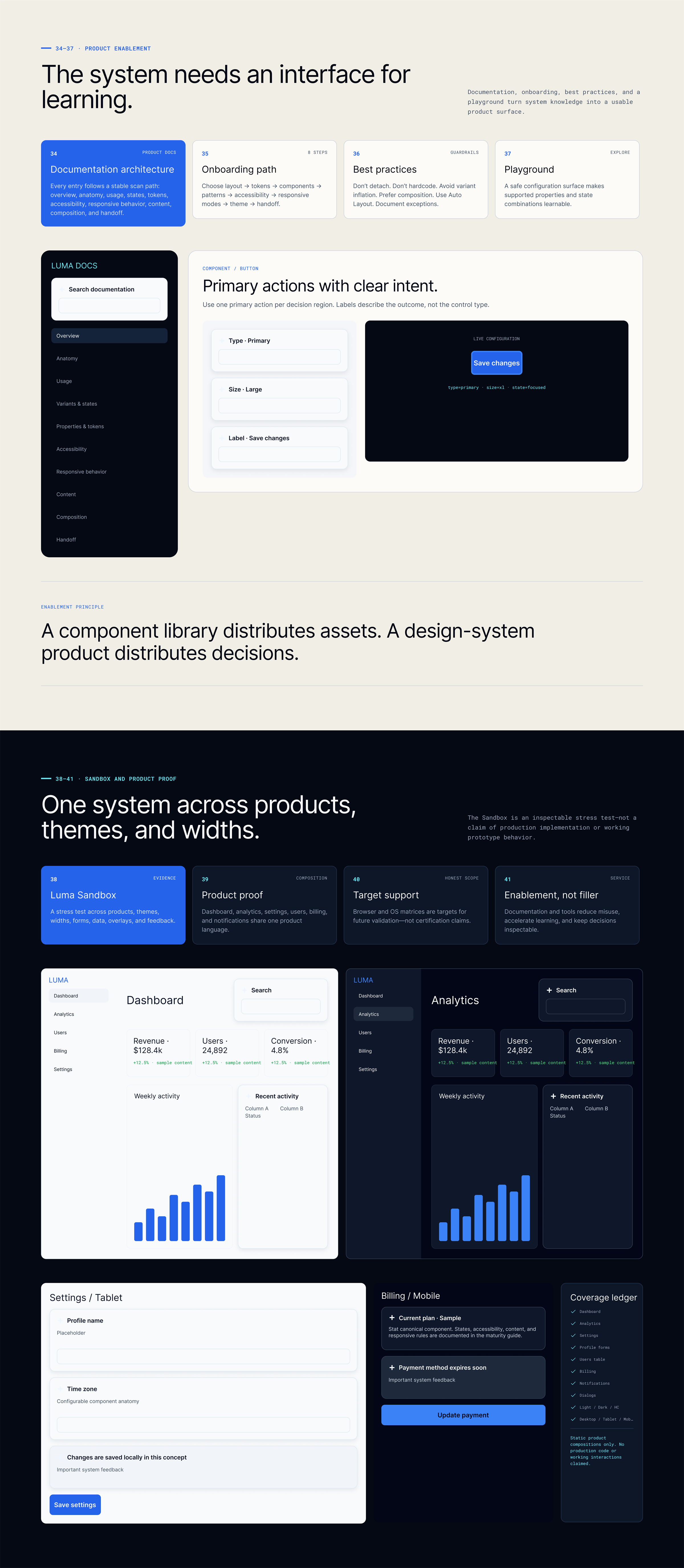
ACT 05 // 08 ENABLEMENT & PROOF

One system across products, themes, and widths

Interactive documentation architecture, component playgrounds, and production stress tests across light, dark, and mobile surfaces.

LUMA Act 5 — Enablement and Proof. Multi-theme support, responsive layouts, and living documentation.
Click to zoom & inspect
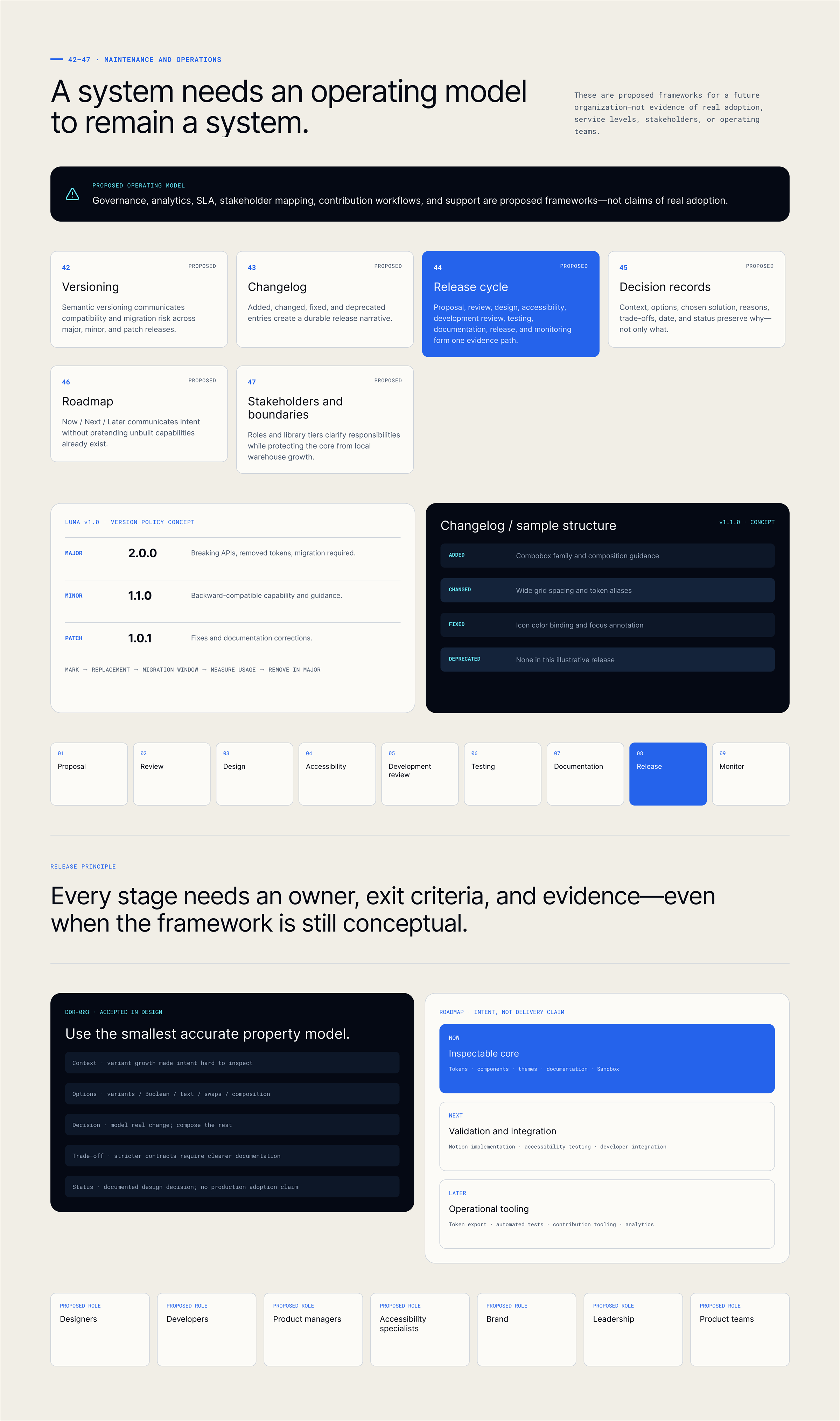
ACT 06 // 08 OPERATIONS & RELEASE

A system needs an operating model to remain a system

Semantic versioning, changelog structures, proposal lifecycles, and architecture decision records preserving the 'why'.

LUMA Act 6 — Operations. Semantic versioning, changelog models, release pipelines, and stakeholder boundaries.
Click to zoom & inspect
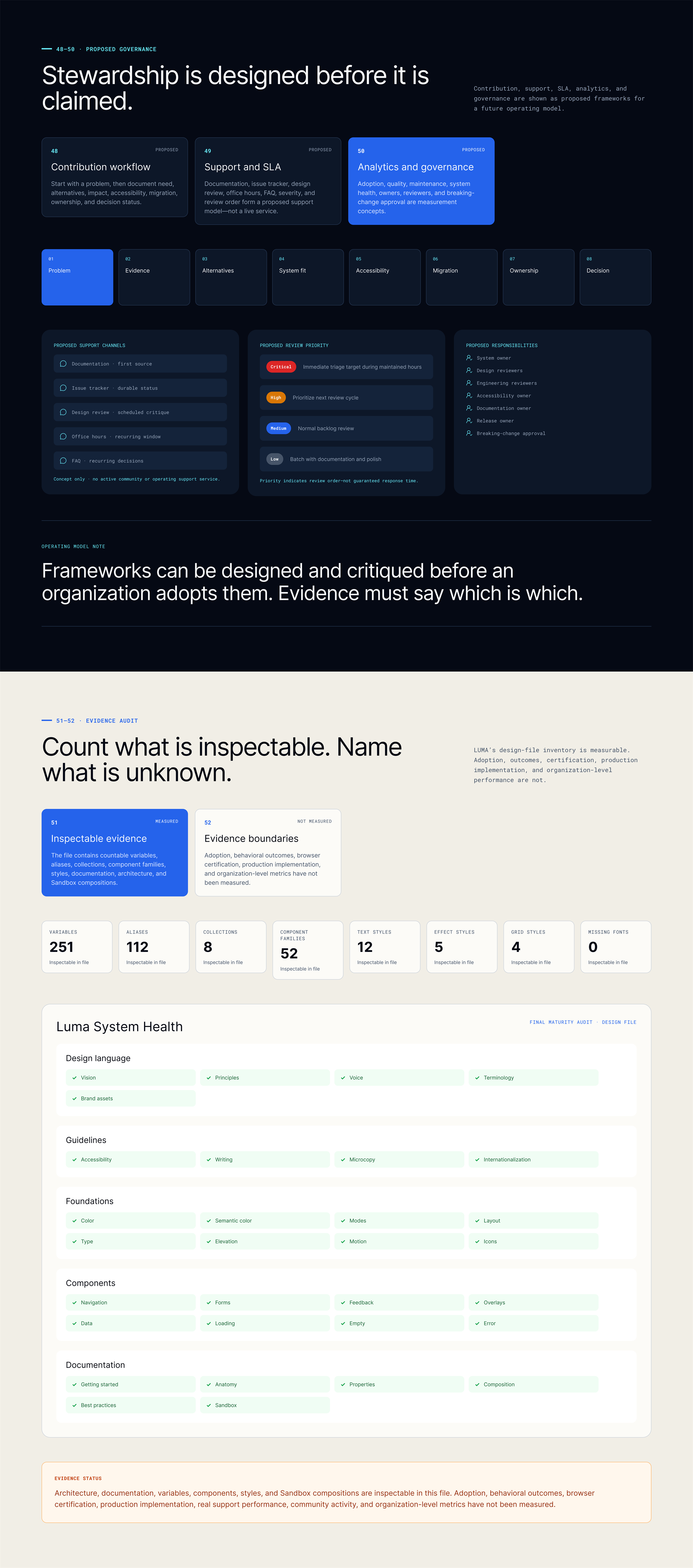
ACT 07 // 08 GOVERNANCE & EVIDENCE

Stewardship is designed before it is claimed

Contribution workflows, inspectable evidence boundaries, adoption metrics, SLAs, and the LUMA System Health scorecard.

LUMA Act 7 — Governance and Evidence. Stewardship models, contribution pipeline, and system health scorecard.
Click to zoom & inspect
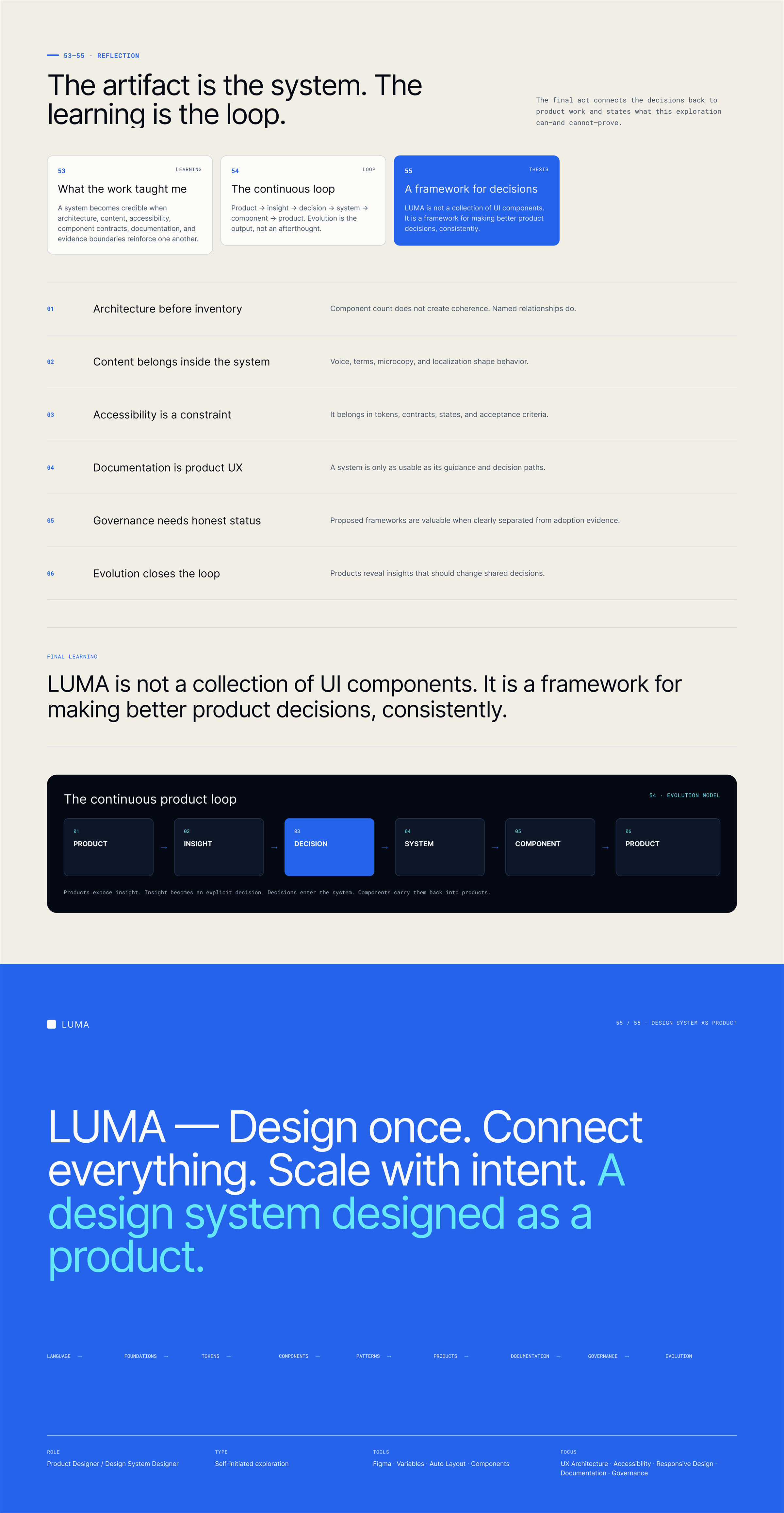
ACT 08 // 08 LEARNING & CLOSE

The artifact is the system. The learning is the loop.

Connecting decisions back to product outcomes, retrospective insights, and closing the continuous product loop.

LUMA Act 8 — Learning and Close. Retrospective reflection, continuous loop, and framework close.
Click to zoom & inspect